


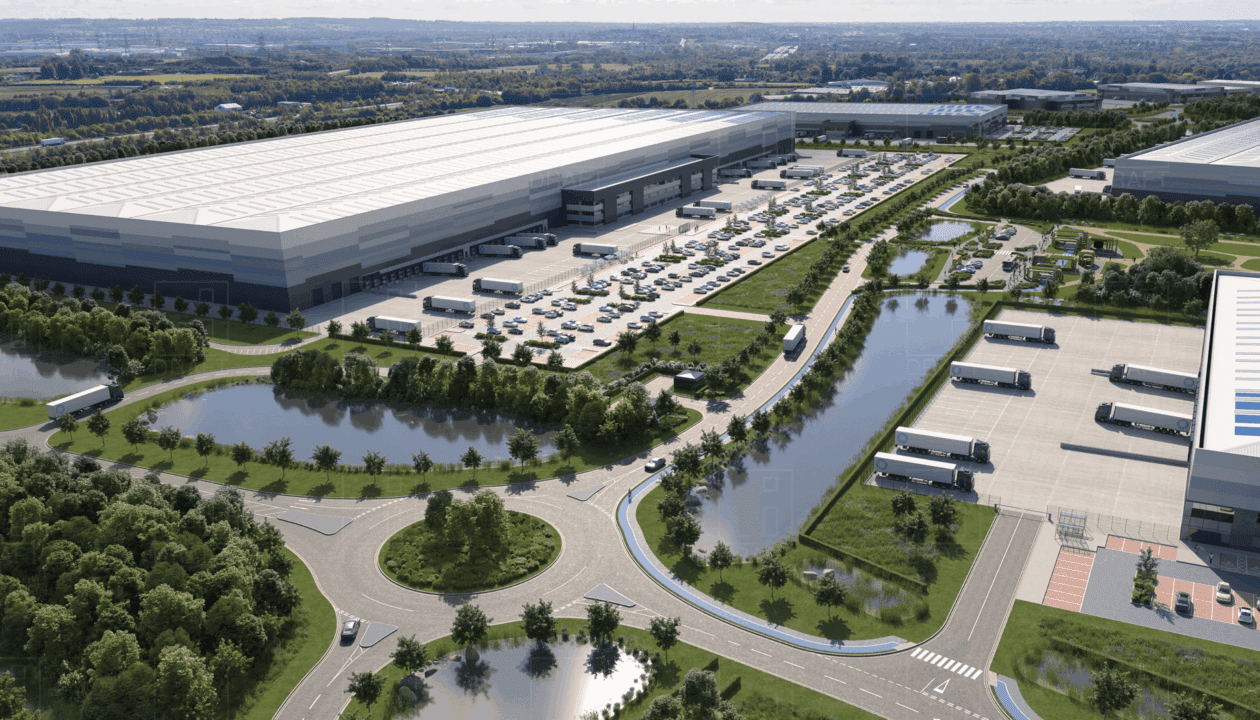
As the UK moves toward a net-zero economy, Simon Seaton-Smith, our Director of Innovation and Sustainability, talks about how large-scale industrial and logistics developments like our proposed Thrive scheme in North Warwickshire could represent a game-changing opportunity to reshape how we generate clean energy and manage its supply to help drive regional growth.
The proposed £343 million forward-thinking employment park near Curdworth, Junction 9 of the M42 could create between 4,400 and 6,000 full-time jobs on-site when fully occupied and generate £350 million in annual GVA, delivering circa. £9 million a year in business rates.
Spanning some 80 hectares Thrive is designed as a strategic, forward thinking employment park with energy resilience built in from the start supporting emerging clusters in advanced manufacturing, R&D, and logistics.
The growth opportunity lies in the design detail and Thrive’s sheer scale to deliver clean energy, against a context of an existing infrastructure network lacking the sophistication to fulfil the UK’s current and emerging requirements.
Regional Resilience
The existing energy grid is struggling to keep up with demand, with connection queues lengthening as low-carbon industries and digital infrastructure – particularly data centres – expand rapidly, with some not expecting to be in operation on current schedules until 2035 and beyond, despite securing planning permission.
There are also more mid-sized and small manufacturers in the West Midlands than anywhere in the UK who are struggling with rising energy costs and would equally struggle to find the investment to convert their existing operations to clean green energy.
Regional growth depends on reliable, affordable, and sustainable energy. As the West Midlands looks to transition from traditional industries to a low-carbon, innovation-driven economy, energy infrastructure and planning will be central to achieving its long-term prosperity.
Flexible and Affordable
This was highlighted at the West Midlands Industrial Electricity Dialogue recently, hosted by National Grid Electricity Distribution (NGED) in partnership with the Black Country Industrial Cluster and WMCA at Birmingham University, where regional industrial leaders and policymakers gathered to discuss the need for timely, affordable access to clean electricity.
The event reinforced the importance of forward planning, smart connections, and collaboration and partnership between developers and the Distribution System Operators (DSO).
WMCA’s Ambitions
The West Midlands Combined Authority (WMCA) has set an ambitious target to reach net zero by 2041, and the West Midlands Regional Energy Strategy and WM2041 Five-Year Plan prioritise industrial decarbonisation, local generation, and smart grid systems as core enablers of competitiveness.
On our current trajectory with energy supply the region will struggle to achieve its ambitions.
However, within that framework, the WMCA identifies rooftop solar PV on industrial and commercial buildings as a strategic focus (WMCA Five-Year Plan – Industrial Sector Analysis), supported by initiatives like the Bright Solar Future programme (Midlands Net Zero Hub, 2024).
Thrive takes WMCA’s desire for use of solar PV and clean energy a step further by using the critical scale of the scheme to deliver the energy it requires and more, offering up a template for future large scale industrial and logistic schemes and a partnership approach to power.
The UK Warehousing Association says placing solar panels onto the UK’s larger warehouses could double solar generation capacity. While not an entirely new concept, it’s not been widely adopted to date either in the UK or globally. However, AI, climate change and energy security is aligning for some ‘big box’ thinking to push forward alternative solutions.
Industrial Roofs: The New Power Stations
With over 3.1 million sq ft of roof space proposed at Thrive and similar developments, there is the scale to host renewable generation, battery storage, and digital infrastructure to power operations.
A single million-square-foot roof can host 5–6 MW of solar PV, enough to power the energy required for thousands of homes annually or to supply to surrounding local businesses.
When paired with on-site battery systems, this creates localised energy resilience, utilising private wire and microgrid technologies, enabling businesses to balance their own demand, reduce dependency on the national grid, and even export surplus energy back into it.
NGED is currently developing new flexibility and resilience markets to help shape how local energy is managed and balanced. Among these is a new Demand Turn Up (DTU) product, due to launch in summer 2026, which will incentivise businesses to increase energy use when renewable generation is at its peak. This encourages smarter use of clean energy, supports on-site renewables, and helps maintain grid stability during times of high renewable output.
For businesses, this opens new opportunities to lower costs, generate income, and actively support a more reliable and sustainable regional power network.
Forward Planning
By integrating clean energy infrastructure at scale at its inception, Thrive could share its excess renewable energy, relieving pressure on the wider grid, supporting power-intensive uses such as data centres, and strengthen the West Midlands’ position as a leader in clean, resilient industrial growth.
For Thrive, a carbon-led infrastructure is about actively contributing to de-carbonisation rather than merely complying. It’s about creating a truly future facing, sustainable scheme with Net Zero Ready buildings and BREEAM Outstanding standards combined with over 50% of green infrastructure to enhance the working environment and long-term wellbeing of the business and wider community.
Thrive: Building Energy Resilience into the Region’s Future
It’s what could be the industrial parks of tomorrow, which not only manufacture, design and distribute goods, but stimulate innovation, generate clean energy, store it locally, and power digital infrastructure that underpins the modern economy.
By combining industrial development, renewable energy generation, and digital infrastructure, Thrive and similar schemes can serve as blueprints for how Britain powers its industries and data-driven future in a clean, efficient and resilient way.
In doing so, the West Midlands can demonstrate what WMCA’s vision truly looks like in practice: a low-carbon economy that grows through foresight, innovation, and energy security.
Author

Back to news page