


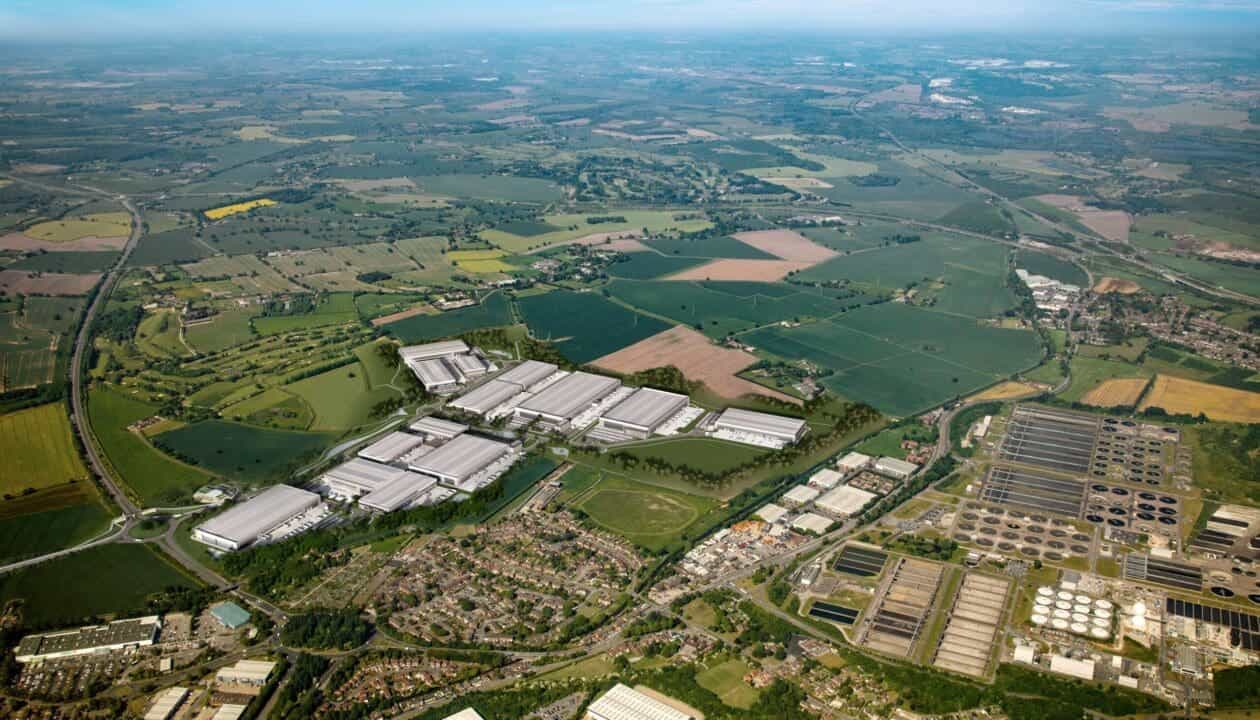
Our Group Sustainability Manager Andy Swain, spoke with React News about what developers are doing to design logistics’ schemes to meet sustainability challenges – and appeal to the people who will work there.
Industrial and logistics (I&L) may often be perceived to be behind the curve when it comes to sustainable development and wellbeing, however the rise in requirements and a relatively new phenomenon in the labour market has focussed everyone’s attention.
Traditionally, logistic operators competed only with their peers for staff, but as the level of robotics and automation continues to rise, the need for manual operatives is falling, making way for more technically qualified recruits, which means competing for labour in nearby Grade A offices.
Now sustainable Industrial & Logistics schemes have become about more than reducing carbon, but about the wider health & wellbeing of employees in-line with professional and managerial sectors, in addition to delivering long-term positive impacts for local economies and people surrounding these schemes.
At the design phase, there is more focus on the need for open space, higher ceilings and more windows in the communal areas, skylights in the warehouse space, and anything which brings the outside in and creates more natural light and air into the environment.
Increasingly occupiers are requesting enhanced canteen facilities, amenities such as gyms and greater provision of space for employees to relax and enjoy breaks.
At IM Properties’ latest scheme, Peddimore in Birmingham, offering 2.7 million sq ft of manufacturing and logistics space, we’ve turned our attention to what we can do for the scheme overall. Our approach is to create a more experience led environment with amenities to benefit everyone.
We have used an existing brook and designed in green open spaces, referred to as ‘pocket parks’ connecting through green infrastructure. Walking, running and cycle routes will network through the scheme past public art commissioned from the local community.
We’re taking what we’ve learnt from our business parks to create pop-up events to help people connect and landscaped areas to improve the local biodiversity and the overall appeal and environmental efficiency of the scheme.
It’s also about engaging with local communities and enabling them to see the positive social and economic benefits through community funds and promoting skills and training.
Delivering Net Zero Ready buildings is more challenging and that’s why, in part I have been appointed, as group sustainability manager for IM Properties.
The ultimate aim is to remove as much carbon as possible through working with supply chains and adapting the design of buildings, however while legislation is still evolving and the availability of viable new low-carbon materials prohibitive, off-setting is still going to play a large role.
Equally, as the sustainability debate evolves, we must make the case to occupiers that, whether it’s new-build space or a refurb, there are tangible bottom-line benefits to investing in best in class and sustainable workplaces and preparing them to be Net Zero in operation.
To achieve this, developers need to engage and understand an occupier’s views on fit-out and facilities well in advance.
Easy wins are features such as photovoltaic panels which lend themselves to the flat expanses of roofs on logistic units, rainwater harvesting systems and sustainable drainage systems (SUDs). Smart lighting systems and the infrastructure for electric vehicle charging should also now be standard.
The I&L sector’s desire to decarbonise doesn’t stop at facilities, we also need to factor in the future of distribution networks. The road freight sector, contributed up to 19% of the UK’s domestic transport’s annual greenhouse gas emissions (GHG) in 2020.*
We recognise the transition to zero emission HGV’s presents a challenge. There’s an ongoing debate, for instance, about whether delivery vehicles will be powered by battery technology, electric charging or hydrogen. We’ll need greater clarity from government on infrastructure requirements and the need for investment to plan for the future.
Early engagement with occupiers on sustainability elements are crucial and we need to push the boundaries further and continue to innovate where we can.
Many developers have strategies for sustainability and commitments to low carbon, however, it’s important they’re not just seen to be ticking boxes. What will ultimately be the key differentiator and set developers apart is around taking action and delivery – in every aspect of the buildings.
Having conversations internally and externally, challenging the status quo and changing behaviours is crucial, because the learning process around sustainability in all its forms can never end.
*UK Government – Outcome and response to the consultation on when to phase out the sale of new, non-zero emission HGV’s
Author

Back to news page